
PROGRAMME PROFILE
At a glance
- Organiser
- Stanford Pre-Collegiate Studies
- Destination
- United States
- Format & duration
- Online / campus or hybrid · 3–4 weeks
- Age / stage
- Grade 10–11
- Type
- Research & selective
- Information year
- 2027
Sources checked: 2026-11-10 · Facts and editorial guidance are labelled separately
Learning and approach
- Advanced pure mathematics
- Problem sets and research reading
- Collaborative investigation and exposition
Academic content in depth
SUMaC explores advanced pure mathematics, including abstract algebra and number theory or algebraic topology. Lectures, guided research and group problem-solving address concepts, their development and applications. It is not a general taster for every preparation level: strong algebra, geometry and proof experience matter when working with abstract language.
Classes, assignments and workload
In 2027 the online format lasts three weeks and the residential format four. The official site emphasises academic rigour in both. Online students participate live in classes, problem-solving and collaboration, with substantial assignments beyond meetings; residential participants also have evening and weekend activities. Neither format awards grades or credit, and a final presentation is not a publication guarantee.
Eligibility and international applicants
Applicants must be in grades 10 or 11. Students who will be 18 or older during the programme are not eligible for residential SUMaC, but may be eligible online. Strong algebra, geometry and proof skills are expected.
Dates and costs
Schedule
2027 online: June 14–July 2 or July 5–23; residential: June 20–July 16. Application deadline: January 7, 11:59 p.m. Pacific Time.
Costs
Current full costs require verification. Check tuition, accommodation, meals, insurance and travel inclusions.
Fit and preparation
A strong fit for students already comfortable with proof. Use the admission problems to assess your readiness, and consider time-zone demands for online sessions.
Application preparation
Try extended proof tasks and check whether you can explain every step, not just reach an answer. Read the current application-problem rules before planning independent work. Check current grade and residential age restrictions separately. For online study, convert Pacific meeting times to Beijing time and avoid competing commitments that prevent full attendance.
Choosing well and reflecting on outcomes
SUMaC may suit students comfortable with abstraction who want mathematics to be their main summer commitment. Compare formats through independence, time zones, cost and interaction rather than assuming residential study is academically superior. Preserve revised problem sets, research reading notes and your own contribution to the final presentation.
Frequently asked questions
Is online SUMaC self-paced?
No. The online format requires live attendance at specified times and active participation in discussion, problem-solving and collaboration.
Does SUMaC award Stanford credit?
No. It is academic enrichment without course credit or grades.
Can an 18-year-old choose the residential format?
Students who are 18 or older during the programme are not eligible for the residential format. Check the separate online eligibility rules.
Official sources and verification
- Official source 1 ↗sumac.spcs.stanford.edu
- Official source 2 ↗sumac.spcs.stanford.edu
- Official source 3 ↗admitted.spcs.stanford.edu
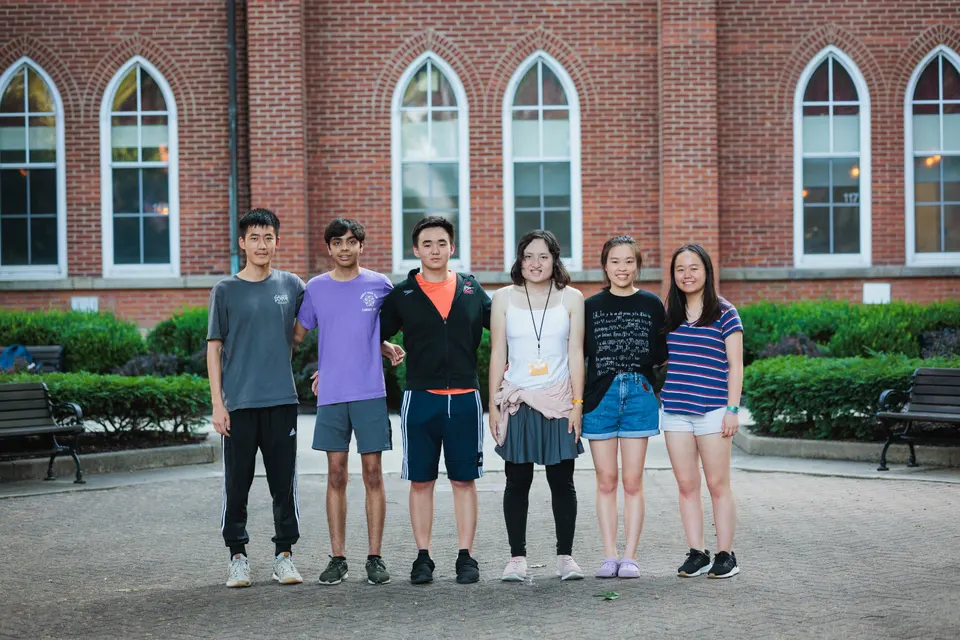
Check the relevant official edition for fees, eligibility and sessions. Images primarily use official programme or university material, with other sources credited separately. They illustrate programme or campus context, not a specific current-year class.