PROGRAMME PROFILE
At a glance
- Associated institution
- Mathematics Foundation of America
- Destination
- United States
- Format & duration
- On campus · 5 weeks
- Age / stage
- 13–18
- Type
- Academic courses
- Information year
- 2026
Sources checked: 2026-11-17 · Facts and editorial guidance are labelled separately
Learning and approach
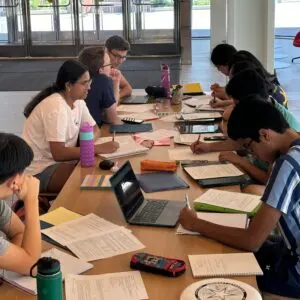
- Choose courses at different levels in areas such as algebra, topology, analysis and graph theory, with supported problem discussion.
Topics and research areas
- Official examples include abstract algebra, topology, real analysis, model theory and spectral graph theory, alongside applied mathematics and some computing and physics. Offerings change and students need not follow one common syllabus. Official source ↗
- The curriculum combines proof techniques and foundational linear algebra, group theory, number theory and graph theory with tracks in algebra, analysis, topology, combinatorics and geometry. Faculty redesign offerings annually; detailed schedules appear near the start. Official source ↗
Mentors, teaching team and academic support
Mentors and teaching team
- Academic staff teach courses, guide projects and provide TAU discussion time for questions and independent exploration. Check the roster for the relevant year. Official source ↗
- 2026 faculty examples: Ben Dees taught at Brown and researched harmonic maps into metric spaces; Charlotte Trainor taught at Harvard with analysis training; Kevin Carde focused on algebraic combinatorics. These are historical appointments. Official source ↗
- 2026 mentors included MIT graduate student Della Hendrickson, studying computational complexity, and Harvard graduate student August Liu, studying algebraic number theory. “Mentor” is a teaching/counselling role, not a professorial title. Official source ↗
Academic support and research resources
- A typical Tuesday–Saturday academic day has morning and early-afternoon classes followed by TAU and a colloquium. Choice and discussion are central; the 2027 timetable remains subject to that edition’s publication. Official source ↗
Eligibility and international applicants
For students worldwide aged 13–18, with precalculus or equivalent preparation and sufficient English for mathematical discussion. Application work emphasises reasoning and explanation.
Dates and costs
Schedule
2026 reference: 28 June–2 August at Champlain College, Vermont. Applications opened 12 January and closed 23 February. The provider expects to announce 2027 dates and location in December.
Costs
The 2026 base fee is $7,500 including tuition, room, board, activities and local airport transfers, with no application fee. International applicants may receive partial or full need-based aid and travel support.
Official source ↗PROVIDER INFORMATION
Details from the provider
Application materials
- The 2026 application included mathematical background and activities, About You, one recommender, and qualifying-quiz solutions with scratchwork and resources used. Aid is optional; transcripts and standardised scores are not normally required. Official source ↗
Fit and preparation
For students who enjoy sustained thinking, proofs and choosing their own learning path. The Canada/USA name does not imply simultaneous sites in both countries.
Official sources and verification
- Official source 1 ↗www.mathcamp.org
- Official source 2 ↗www.mathcamp.org
- Official source 3 ↗www.mathcamp.org
- Official source 4 ↗www.mathcamp.org
- Official source 5 ↗www.mathcamp.org
- Official source 6 ↗www.mathcamp.org
- Official source 7 ↗mathcamp.org
- Official source 8 ↗www.mathcamp.org
Check the relevant official edition for fees, eligibility and sessions. Images primarily use official programme or university material, with other sources credited separately. They illustrate programme or campus context, not a specific current-year class.